PHYSICS 556 -- SOLID STATE II
(Many Body Perturbation Theory in Solids)
Spring Semester 2004
course web page http://felix.physics.sunysb.edu/~allen/556/
Instructor: Philip
B. Allen (philip.allen@sunysb.edu)
office Physics B-146;
hours: Mon 3-4; Wed. 4:00-5:00
contrary to previous information!
The class will meet in Physics
B-131, MWF 10:40-11:35 am
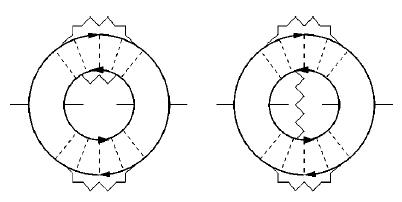
Diagrams with interaction (shown as zigzag lines) contributing to conductance
fluctuations. The left diagram is included in the diffuson, whereas the
right diagram is not. The difference of inelastic rates between weak
localization and conductance fluctuation is a consequence of the missing
diagram. I. L. Aleiner and Ya. M. Blanter, Phys. Rev. B 65, 115317 (2002). |
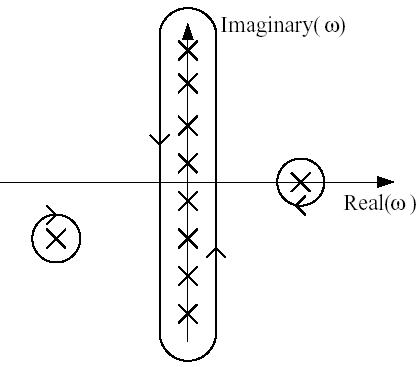
Contours for evaluating the response function (Doniach and Sondheimer,
p. 226. Either the long vertical contour or the two circular contours
may be used. |
|
|
course schedule
midterm exam -- none
final exam -- none |
Notes (pdf format)
notes
#0 (typos in D&S)
notes
#1 (notation)
notes
#2 (linear response)
notes
#3 (Poisson sum formula)
notes
#4 (electrical conductivity) |
assignment schedule
Prob
set #1 due Fri. Feb. 13
Prob
set #2 due Fri. May 14 |
book
list
Tat-Sang Choy's Fermi
surface
data
base; periodic
table of the
Fermi
surfaces. |
|
|
|
|
|
|
|
|
|
|
|
|
Bulletin Description: The course focuses
on the many-particle aspects of solid state physics addressing classical
topics such as superconductivity and the transport properties of disordered
conductors, as well as more modern subjects including the fractional quantum
Hall effect, dissipative quantum mechanics, and problems of mesoscopic
physics. Both phenomenological and theoretical descriptions are discussed.
Spring, 0-3 credits, ABCF grading
Prerequisite: Phy 555 or permission of instructor
Syllabus for Spring 2004
I. Aims of the course: The main topic is perturbation
theory in many body systems. The philosophy is to use the theory
to describe real phenomena in solids, and to use simple model systems as
guides to understanding real data. The course will follow the text
closely, including the topics of X-ray singularities, the Kondo problem,
and superconductivity.
II. Procedures and Requirements: There will be
homework problems assigned (7 problem sets over the semester.) Instead
of exams, there will be a project. This will be chosen by the student
in consultation with the instructor, and can be presented either as a lecture
or as a paper. The instructor will be happy to suggest and discuss
topics for projects and to help students with the project work.
III. Grading: The grade will be based on homeworks
(65%) and on the project (35%).
IV Required
text:
S. Doniach and E. H. Sondheimer, Green's Functions for Solid
State Physicists, Imperial College Press, new edition, 1998 (paperback.)
V. Academic Honesty: Discussions with fellow
students are strongly encouraged, but work which is submitted for grading
must be in your own words. You should review the definition of plagiarism.
VI.Americans with Disabilities Act: If you have
a physical, psychological, medical or learning disability that may impact
your course work, please contact Disability Support Services, ECC (Educational
Communications Center) Building, room 128, (631) 632-6748. They will
determine with you what accommodations are necessary and appropriate. All
information and documentation is confidential.
Students requiring emergency evacuation are encouraged
to discuss their needs with their professors and Disability Support Services.
For procedures and information, go to the following web site.
<http://www.ehs.sunysb.edu/fire/disabilities/asp>
pba, 4/26/2004